

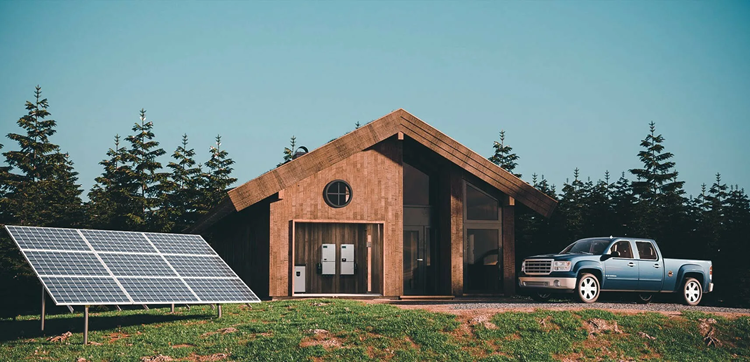
An off-grid system has one rule that grid-tied systems can ignore: every kilowatt-hour has to be produced on site or stored in advance. There is no utility to fall back on when the weather turns.
That makes sizing less forgiving and planning more important. The reward is a house that has power whether or not the distribution company ever reaches it.
Start with a full energy audit, not a wish list. Record every appliance, its power and its daily hours. Include the small loads people forget: phone chargers, the router, the security camera, the gate motor. Add the water pump, the fridge and the freezer with their duty cycles. Then add up the watt-hours for a normal day and a heavy day. The heavy day is the one that sizes the system.
Decide how much autonomy you need. One cloudy day is easy. Three cloudy days in a row require a much larger battery, and the cost rises quickly. A practical compromise is a battery that covers one to two days of essential load plus a generator for the rare long stretch. Many off-grid homes keep a generator for the rainy season, not as a daily source but as a safety net.
The array has to cover the daily load and recharge the battery. In Nigeria, the sun is strong for most of the year, but harmattan dust and the rainy season reduce output. Plan for the worst month, not the best. Keep the array clear of shade and make it easy to clean. A few panels that are always clean outperform a larger array that is never maintained.
Battery choice drives the rest of the design. Lithium iron phosphate packs are common because they accept high charge currents and have a long cycle life, but they cost more up front than lead-acid. Lead-acid is more tolerant of abuse in some ways but needs regular watering and has a shorter life at deep discharge. For a remote house where service visits are expensive, the lower maintenance of lithium is often worth the price.
A 12-14 kW off-grid inverter suits a large family compound with a borehole, refrigeration and several buildings, because the output can carry multiple circuits and the battery voltage is high enough to keep currents manageable. The exact model should follow from the load audit. The important point is to choose an inverter with a clear surge rating and a battery compatibility list, not just a large number on the box.
Distribution is part of the design. An off-grid house usually needs its own mini distribution board with separate circuits for lights, sockets, pump and outbuildings. Long cable runs cause voltage drop, especially at 230 V, so keep the inverter near the main loads and use adequately sized cable. Label the circuits and install surge protection. A remote house is a bad place for improvised wiring.
Generator integration should be planned from the start. A generator input on the inverter lets the battery charge during a long cloudy spell without rewiring the house. Set the generator to run at a healthy load rather than idling, and make sure the changeover prevents backfeed. The generator does not need to be large. It needs to be reliable and to charge the battery efficiently.
Monitoring matters even more off-grid. The owner needs to see the battery state, the daily yield and the load. A simple app is enough, but the habit of checking it is what prevents a blackout. Set a reserve threshold and treat it as a hard limit. When the battery reaches it, shed the optional loads before the inverter shuts down. An off-grid system is managed, not just installed.
Off-grid solar is not a smaller version of a grid-tied system. It is a small power station with its own rules. The design starts with energy, not equipment. Once the audit, the autonomy target and the worst-month yield are clear, the hardware follows. A house that is planned this way can run for years with routine cleaning, occasional battery checks and a generator that rarely starts.